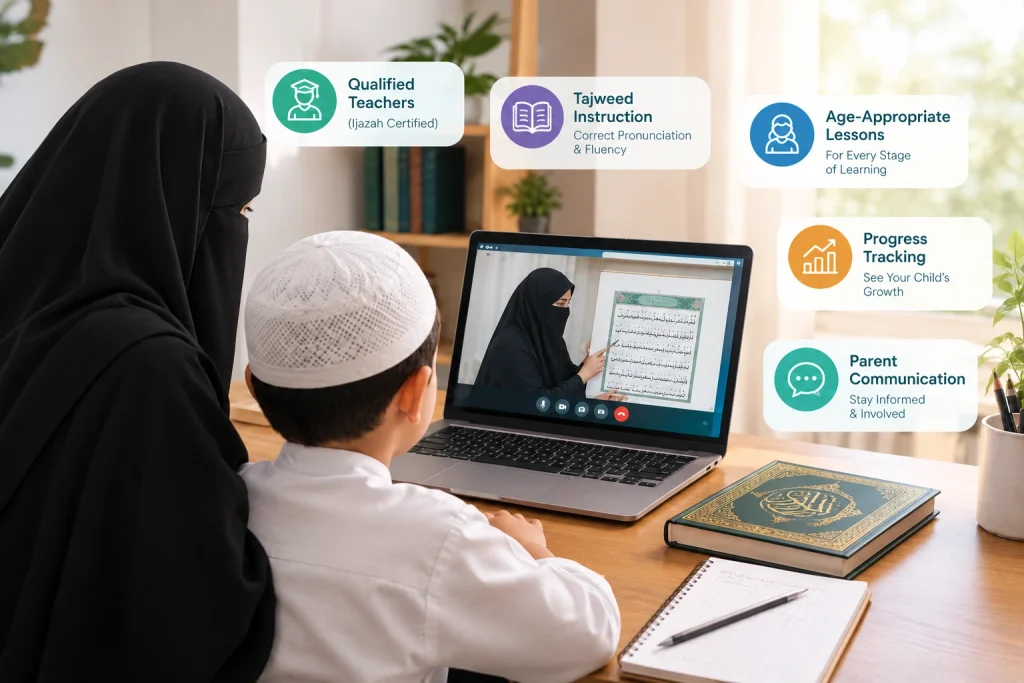
Choosing an online Quran academy means checking more than class times and fees. You need to know who will teach your child, how they teach, and whether their Quranic qualifications can be verified. Look for Ijazah-certified teachers, proper Tajweed instruction, age-appropriate lessons, progress tracking, and clear parent communication.
Introduction
As a Muslim parent, you want your child to build a strong relationship with the Quran. You also want that learning to be accurate from the beginning.
This is where choosing an online Quran academy can feel difficult. Many academies offer similar courses, flexible schedules, and promises of qualified teachers. But what does “qualified” actually mean?
One of the biggest concerns parents have is simple: “What if my child learns incorrectly and develops bad habits?”
That concern is valid. A child may repeat the same pronunciation mistake many times before anyone notices it. Early errors in letter sounds, Makhraj, or basic Tajweed can become harder to correct later.
The good news is that you can reduce this risk by asking the right questions before enrolling. The following ten questions will help you compare academies based on teacher qualifications, teaching quality, child suitability, and long-term support.
You can also try our free trial class.
Want to see the teaching approach before making a decision? Al Hamd Islamic Center offers a free trial class, giving you and your child a chance to experience the learning environment before enrolling.
Who This Guide Is For
This guide is especially useful if you are a Muslim parent in the USA, UK, Canada, or Australia looking for:
- An online Quran teacher with verifiable Islamic qualifications
- Quran classes with Tajweed
- Online Quran classes for kids aged 5–12
- A structured Quran learning path
- Flexible lessons around school and family life
- Regular feedback on your child’s progress
- Teachers who understand the needs of young learners
The right academy should make you feel informed, not pressured. You should know who teaches your child and what your child will learn next.
Why Choosing the Right Online Quran Academy Matters
Convenience Is Not Enough
Online learning can make Quran education much easier for busy families. Your child can learn from home without spending time travelling to a physical center.
But convenience should never replace teaching quality.
A useful lesson is not simply 30 or 45 minutes spent looking at a Quran screen. A good teacher listens closely to the child’s recitation, identifies errors, corrects them, and gives the child a chance to repeat the sound correctly.
For example, if a child struggles with a letter’s Makhraj, the teacher should not simply say, “Read it again.” The teacher should identify the pronunciation issue and guide the child through the correct articulation.
Your Child’s Teacher Matters Most
The academy’s name matters, but the teacher your child meets every week matters even more.
A patient teacher can help a young child stay focused, while a rushed teacher may cause the child to lose interest. A skilled Quran teacher also knows when to correct an error, when to repeat an exercise, and when to move forward.
Students who skip foundational work such as Noorani Qaida may later struggle with fluent Quran reading. A careful teacher notices this early and strengthens the foundation before adding more difficult material.
What a Trustworthy Academy Should Make Clear
Before enrolling, an academy should be able to explain:
- Who will teach your child
- What qualifications the teacher holds
- Whether the teacher has Ijazah
- How Tajweed will be taught
- How lessons are adjusted for age and level
- How progress is measured
- How parents receive feedback
- What happens if the teacher is not a good fit
That level of transparency gives parents something valuable: the ability to make an informed decision.
10 Questions to Ask Before Enrolling in Any Online Quran Academy
1. Are the Quran Teachers Ijazah-Certified and Properly Qualified?
Start with the teacher’s credentials.
Ijazah is an important qualification in Quranic learning. It reflects a chain of authorization connected to qualified scholarship and Quranic transmission. However, parents should not stop at the word “Ijazah.” Ask what the teacher studied, where they studied, and what area they specialize in.
A strong teacher profile may include qualifications such as:
- Ijazah in Quran recitation
- Hifz or Quran memorization
- Tajweed specialization
- Dars-e-Nizami education
- Training from a recognized Jamia
- Qirat qualifications
- Islamic Studies education
At Al Hamd Islamic Center, the teaching team includes 200+ Ijazah-certified teachers. The academy also highlights teachers with backgrounds in Dars-e-Nizami, Hifz, Tajweed, Qirat, and Islamic Studies.
This is important because “qualified teacher” can mean many things. A transparent academy should tell you what the qualification is, rather than asking you to trust a general label.
2. What Qualifications Does the Online Quran Teacher Actually Have?
Once you know that an academy has qualified teachers, ask about the specific person teaching your child.
A useful teacher checklist includes:
- Teacher’s full name
- Islamic institution or Jamia attended
- Ijazah or Quranic certification
- Tajweed or Qirat specialization
- Hifz background, where applicable
- Teaching experience
- Experience teaching children
The key question is not simply, “Does this academy have teachers?”
Ask: “Who will teach my child, and what makes that teacher qualified to teach the Quran?”
3. Does the Academy Offer Quran Classes With Tajweed?
Reading the Quran correctly is more than recognizing Arabic letters.
Tajweed teaches the rules and proper manner of Quranic recitation. It includes areas such as correct articulation, characteristics of letters, elongations, stopping rules, and other recitation principles.
For a young learner, Tajweed should develop gradually.
A teacher may first work on the child’s Noorani Qaida and basic pronunciation. The teacher then observes specific Makhraj problems before introducing more advanced Tajweed rules.
A practical learning path may look like:
- Letter recognition and correct sounds
- Noorani Qaida and basic reading
- Makhraj and pronunciation correction
- Introduction to Tajweed rules
- Applying Tajweed while reading the Quran
- Regular correction and revision
This matters because a child can become a fast reader while still making repeated pronunciation errors. Speed should not be treated as the main goal. Accuracy and confident recitation should come first.
4. Can My Child Take a Quran Academy Trial Class?
A trial class is one of the easiest ways to evaluate an academy before making a commitment.
But do not use the trial only to see whether your child likes the teacher. Watch the teaching process.
During the lesson, notice whether the teacher:
- Assesses your child’s current reading level
- Listens carefully to pronunciation
- Corrects mistakes with patience
- Explains difficult sounds clearly
- Keeps the lesson suitable for the child’s age
- Gives the child opportunities to participate
- Explains what the child should work on next
A five-year-old may need short activities and frequent encouragement. A twelve-year-old may be ready for longer recitation practice and more detailed Tajweed correction.
A good trial should help you answer one question: “Can I see my child learning well with this teacher?”
Al Hamd Islamic Center provides a free trial class as a low-risk way for families to experience the teaching environment before deciding.
5. Are the Online Quran Classes Designed for My Child’s Age and Level?
Children do not learn in exactly the same way.
A child who is five may still be learning Arabic letters and basic Qaida. A child who is twelve may already read the Quran and need focused Tajweed or Hifz support.
The teacher should assess the child’s actual level instead of assuming that age tells the whole story.
For example, two children of the same age may have very different needs. One may know the Noorani Qaida well but struggle with fluent Quran reading. Another may read fluently but need help with specific Tajweed rules.
Age-appropriate online Quran classes for kids should consider:
- Attention span
- Previous Quran education
- Reading ability
- Pronunciation
- Tajweed knowledge
- Memorization goals
- Confidence and learning pace
This type of assessment helps prevent a common problem: giving every student the same lesson plan.
6. Will My Child Have a Consistent Online Quran Teacher?
Consistency can make a major difference in Quran education.
When the same teacher works with your child regularly, they learn the child’s strengths and weaknesses. They may know that your child often confuses certain sounds or needs extra revision before moving to a new rule.
Frequent unexplained teacher changes can make this process harder.
Ask the academy:
- Will my child normally have the same teacher?
- What happens if the teacher is unavailable?
- Can the teacher see previous lesson progress?
- What happens if my child does not connect with the teacher?
- Is there a process for requesting a different teacher?
Teacher continuity should support learning, not become a restriction. If the teaching relationship is not suitable, parents should have a clear way to discuss the issue.
7. How Does the Academy Track My Child’s Progress?
Attendance is not the same as progress.
Your child can attend every class and still need help with pronunciation, fluency, Tajweed, or memorization.
A useful progress system should track actual learning.
Parents should be able to understand questions such as:
- What did my child learn this week?
- Which mistakes are improving?
- Which areas still need practice?
- Is my child ready for the next level?
- What can we practice between lessons?
Regular parent updates also create accountability. You do not have to guess whether your child is moving forward.
8. What Courses Can My Child Progress Into?
Think beyond the first few months.
Your child may begin with Noorani Qaida, but what happens after completing the foundation?
A strong Quran academy should provide a clear learning pathway. Depending on the child’s goals, this may include:
- Noorani Qaida
- Quran Reading
- Tajweed
- Hifz and Quran Memorization
- Tafseer
- Islamic Studies
- Daily Supplications
This creates continuity. A child can move from learning individual Arabic letters to reading the Quran, improving Tajweed, and eventually developing deeper Islamic knowledge.
For example, after a child becomes comfortable with Quran reading, the teacher may focus more heavily on applied Tajweed. A student interested in Hifz may then need stronger revision habits and a structured memorization plan.
9. Are the Class Timings Practical for a Muslim Family in the USA?
The best teacher is not helpful if your child cannot attend lessons consistently.
Families in the USA may be managing school, homework, sports, family activities, and different time zones. A Quran schedule needs to fit into real family life.
Ask about available time slots and whether lessons can work around your child’s school routine.
A practical schedule should also consider your child’s energy level. A young child who has just returned from a long school day may not be ready for a demanding lesson. Another child may learn better during a quieter weekend slot.
Consistency matters more than choosing the longest possible lesson.
10. How Can I Verify the Academy’s Reputation and Trustworthiness?
Do not judge an academy only by how professional its website looks.
Look for evidence that supports its claims.
Check whether the academy clearly provides:
- Teacher names and qualifications
- Information about its curriculum
- Details about Tajweed and Quran instruction
- A trial class
- Parent communication
- Clear course options
- Accessible contact information
- Student or parent feedback
- A transparent teaching process
Also ask how classes are monitored and how concerns are handled.
Trust grows when an academy gives parents visibility into the learning process instead of asking them to accept broad promises.
What to Look For: Online Quran Academy Comparison Table
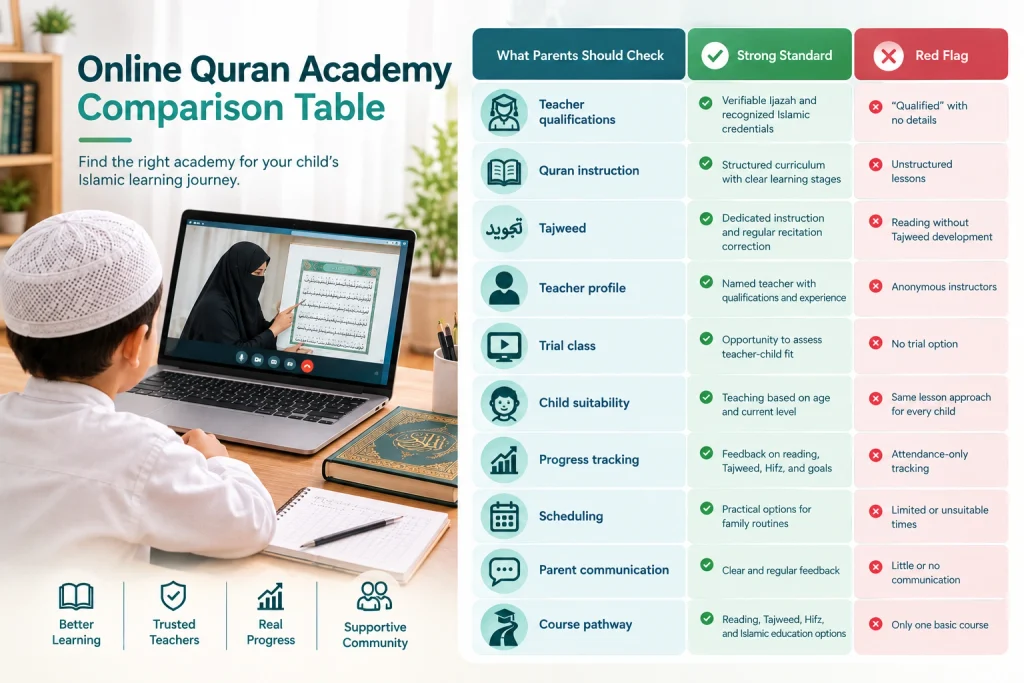
| What Parents Should Check | Strong Standard | Red Flag |
| Teacher qualifications | Verifiable Ijazah and recognized Islamic credentials | “Qualified” with no details |
| Quran instruction | Structured curriculum with clear learning stages | Unstructured lessons |
| Tajweed | Dedicated instruction and regular recitation correction | Reading without Tajweed development |
| Teacher profile | Named teacher with qualifications and experience | Anonymous instructors |
| Trial class | Opportunity to assess teacher-child fit | No trial option |
| Child suitability | Teaching based on age and current level | Same lesson approach for every child |
| Progress tracking | Feedback on reading, Tajweed, Hifz, and goals | Attendance-only tracking |
| Scheduling | Practical options for family routines | Limited or unsuitable times |
| Parent communication | Clear and regular feedback | Little or no communication |
| Course pathway | Reading, Tajweed, Hifz, and Islamic education options | Only one basic course |
The table gives you a simple starting point. But teacher credentials deserve special attention because they affect almost every other part of your child’s Quran learning.
What Parents Should Expect From a Quran Academy
A trustworthy Quran academy should be able to show evidence of its teaching standards through its people, curriculum, and communication.
Verifiable Ijazah-Certified Teachers
Al Hamd Islamic Center places Ijazah-certified teachers at the center of its teaching model. Its stated teaching team includes more than 200 Ijazah-certified teachers.
The wider teaching team includes specialists with different areas of Islamic education.
This range matters because Quran education is not limited to one skill. A child may need accurate recitation today and deeper Islamic Studies later.
Structured Teaching Methodology
A strong Quran program should follow a process rather than depend on random lesson choices.
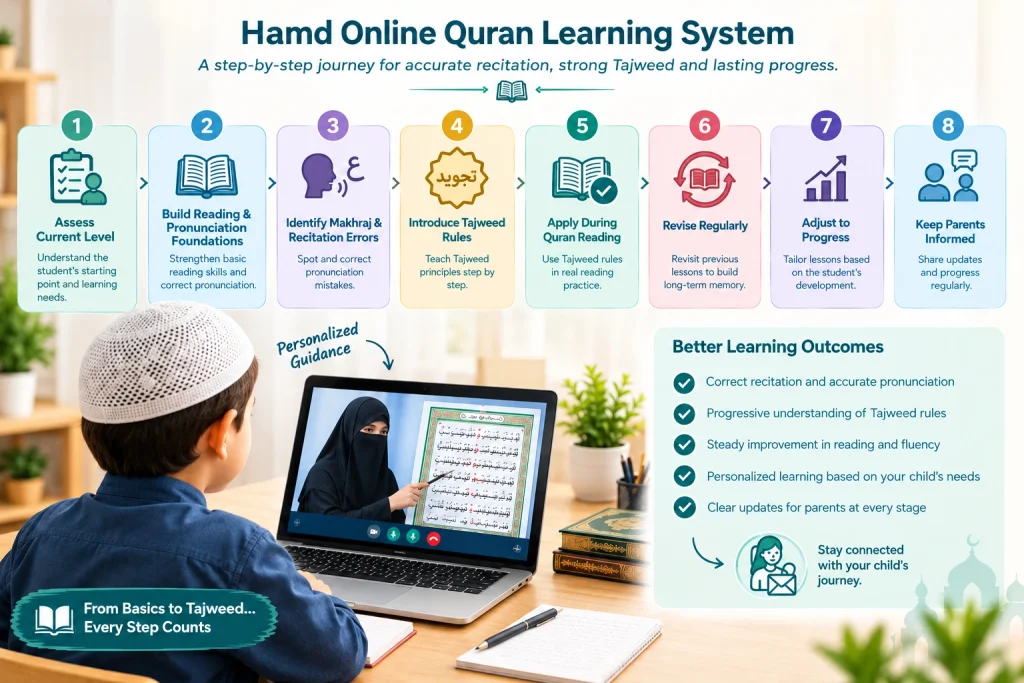
The Hamd Online Quran Learning System can be understood through a simple progression:
- Assess the student’s current level.
- Strengthen reading and pronunciation foundations.
- Identify Makhraj and recitation errors.
- Introduce Tajweed rules progressively.
- Apply those rules during Quran reading.
- Revise earlier material regularly.
- Adjust lessons according to student progress.
- Keep parents informed about development.
This approach helps prevent a child from simply moving through pages without correcting recurring mistakes.
Supervision and Child Safety
Parents should also understand how online lessons are managed.
A responsible academy should maintain professional teacher-student boundaries, appropriate classroom conduct, clear communication, and a system for parents to raise concerns.
Parents should know when lessons take place and who is teaching their child. Clear communication is especially important for younger students.
Progress Tracking
Progress should be visible over time.
An initial assessment gives the teacher a starting point. Later updates can show changes in reading accuracy, Tajweed, memorization, fluency, and lesson goals.
This also helps teachers make better decisions. If a child repeatedly struggles with a particular pronunciation point, the teacher can spend more time on that area instead of rushing to the next lesson.
Trial Class as Risk Reversal
A free trial gives parents something a website cannot provide: a direct experience of the teaching process.
You can listen to how the teacher corrects your child. You can see whether the lesson feels organized. Your child can experience the teacher’s communication style.
That makes the decision more practical and less based on marketing claims.
If you are comparing Quran academies, consider starting with a free trial class. It gives your family a chance to assess the teacher, lesson structure, and learning environment before making a longer-term decision.
Common Mistakes Parents Make When Choosing an Online Quran Academy
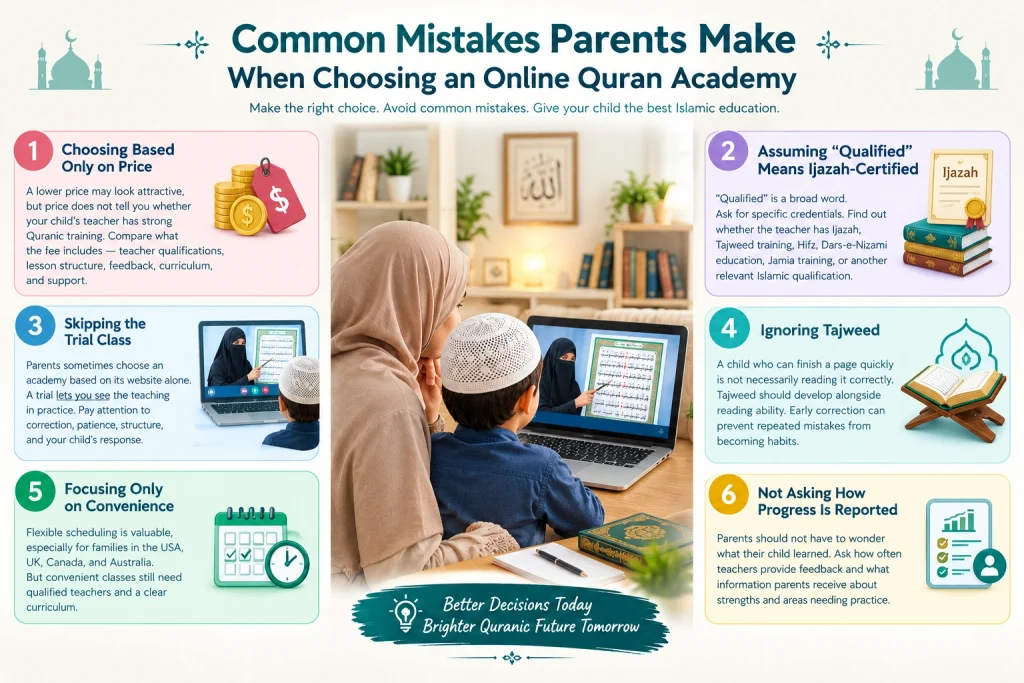
Choosing Based Only on Price
A lower price may look attractive, but price does not tell you whether your child’s teacher has strong Quranic training.
Compare what the fee includes. Look at teacher qualifications, lesson structure, feedback, curriculum, and support.
Assuming “Qualified” Means Ijazah-Certified
“Qualified” is a broad word.
Ask for specific credentials. Find out whether the teacher has Ijazah, Tajweed training, Hifz, Dars-e-Nizami education, Jamia training, or another relevant Islamic qualification.
Skipping the Trial Class
Parents sometimes choose an academy based on its website alone.
A trial lets you see the teaching in practice. Pay attention to correction, patience, structure, and your child’s response.
Ignoring Tajweed
A child who can finish a page quickly is not necessarily reading it correctly.
Tajweed should develop alongside reading ability. Early correction can prevent repeated mistakes from becoming habits.
Focusing Only on Convenience
Flexible scheduling is valuable, especially for families in the USA, UK, Canada, and Australia.
But convenient classes still need qualified teachers and a clear curriculum.
Not Asking How Progress Is Reported
Parents should not have to wonder what their child learned.
Ask how often teachers provide feedback and what information parents receive about strengths and areas needing practice.
What Parents Notice After Starting the Right Online Quran Classes
The benefits of structured learning often appear in small changes first.
Greater Confidence in Quran Reading
A child may begin by hesitating over letters or stopping frequently. With steady practice and correction, reading can become more comfortable and controlled.
The goal is not simply to read faster. It is to read with greater accuracy and confidence.
Better Awareness of Tajweed
Children gradually begin to recognize why certain sounds or recitation rules require attention.
Instead of hearing correction as “wrong” or “right,” they begin to understand what they need to change.
More Consistent Learning Habits
Regular lessons create a routine.
Short, focused practice between classes can also reinforce what the teacher covered. Consistency is especially important for children learning Quran reading or Hifz.
Parents Gain Better Visibility
Regular feedback helps parents understand what is happening during lessons.
You can learn whether your child is improving in reading, struggling with a particular rule, or ready for the next stage.
Children Build a Long-Term Learning Path
The Quran should not become a subject a child finishes and forgets.
A structured pathway can support continued growth from Noorani Qaida to Quran reading, Tajweed, Hifz, Tafseer, and broader Islamic Studies.
What Should Parents Look for in an Online Quran Teacher?
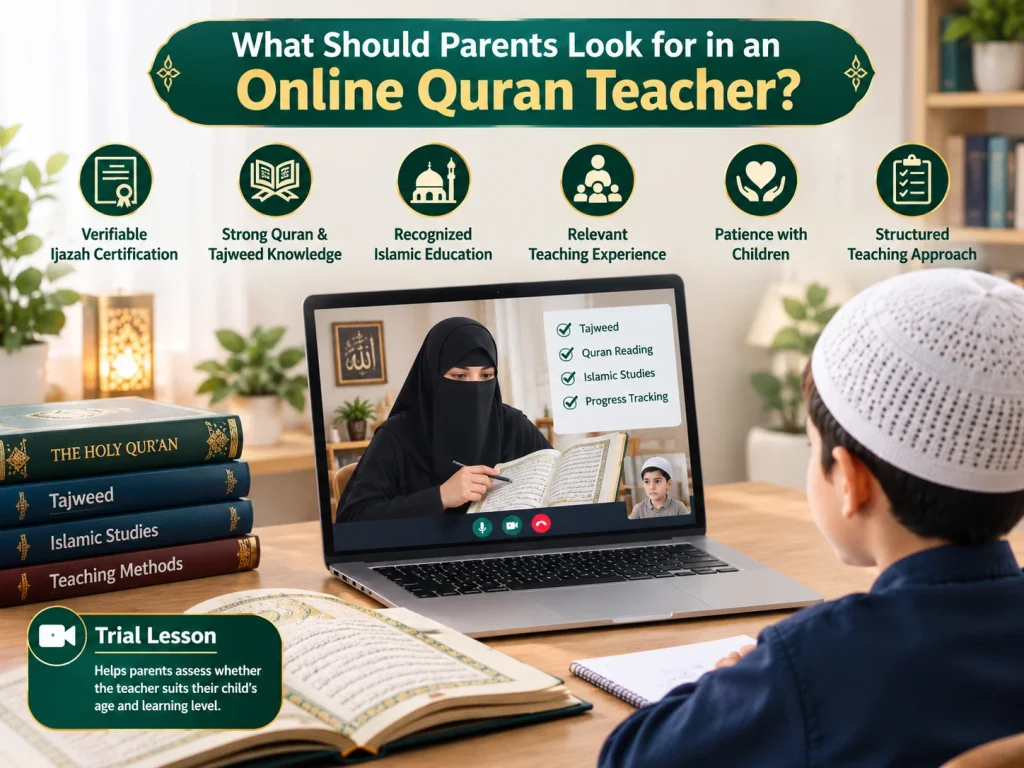
Parents should look for an online Quran teacher with verifiable Ijazah certification, strong Quran and Tajweed knowledge, recognized Islamic education, relevant teaching experience, patience with children, and a structured teaching approach. A trial lesson can help parents assess whether the teacher suits their child’s age and learning level.
Frequently Asked Questions About Choosing an Online Quran Academy
1. How do I choose an online Quran academy ?
Compare teacher qualifications, Ijazah certification, Tajweed instruction, curriculum, trial classes, child suitability, progress tracking, scheduling, and parent communication. Give particular attention to the qualifications of the teacher who will actually teach your child rather than judging an academy only by its website, pricing, or promotional claims.
2. What qualifications should an online Quran teacher have ?
Look for verifiable Quranic and Islamic qualifications such as Ijazah, Hifz, Tajweed specialization, Dars-e-Nizami education, recognized Jamia training, Qirat qualifications, or relevant Islamic Studies credentials. Parents should also consider teaching experience and the teacher’s ability to work patiently and appropriately with children.
3. Are online Quran classes effective for kids ?
Online Quran classes can be effective for children when lessons are structured around the student’s age, level, and goals. Consistent teacher guidance, active recitation practice, Tajweed correction, regular revision, progress tracking, and parent communication all contribute to a more productive online learning experience.
4. Why is Ijazah important when choosing a Quran teacher ?
Ijazah is an important credential because it reflects authorization in Quranic transmission and recitation under qualified scholarship. Parents should still look at the teacher’s complete educational background, specialization, and experience. An academy that transparently identifies its Ijazah-certified teachers gives parents a clearer basis for evaluating instructional trust.
5. What should I expect from a Quran academy trial class ?
A useful trial class should give parents an opportunity to observe the teacher’s communication, patience, Quran-reading assessment, Tajweed correction, lesson structure, and interaction with the child. It should also help determine whether the teacher’s approach and the student’s current level are a suitable match.
6. How can parents know if their child is making progress ?
Parents should receive more than attendance information. A good progress system can monitor Quran reading accuracy, Tajweed development, memorization where applicable, lesson goals, strengths, and areas needing practice. Regular teacher feedback helps parents understand what their child has learned and what should come
Final Takeaway: Choose the Teacher Behind the Academy
Choosing an online Quran academy is ultimately about choosing the right learning environment for your child.
Look beyond attractive websites and convenient schedules. Ask who will teach your child, what qualifications they hold, how Tajweed will be taught, how your child’s progress will be measured, and how parents will be kept informed.
The strongest choice is an academy that provides evidence rather than vague promises. Verifiable Ijazah certification, recognized Islamic education, child-focused teaching, structured lessons, regular feedback, and a practical trial class can help you make your decision with greater confidence.
If your goal is to help your child develop accurate Quran reading habits from the start, take the time to evaluate the teacher behind the academy.
Ready to see whether Hamd Online is the right fit for your child? Book a free trial class and let your child experience the learning environment before you decide.